
Sending sites in seven districts; receiving-site scope expanded across Hong Kong
TPB announced the revisions on 21 August 2026

The Town Planning Board issued Planning Guidelines 43A to relax plot ratio transfer arrangements. Certain old sites that are difficult to redevelop individually may transfer recognised gross floor area to sites better suited for development, supporting urban renewal. The arrangements offer more flexibility for cross-district pairing, but each proposal still requires consideration through a planning application.[1][2]
01 / Comparing the arrangements
Where are the main changes?
The scheme began in Mong Kok and Yau Ma Tei in 2023. The 2026 revision expands sending sites to seven districts and broadens the possibilities for pairing with receiving sites.[1]
| Item | Original pilot arrangements | After the 2026 revision |
|---|---|---|
| Sending-site area | Mong Kok and Yau Ma Tei | Seven designated older districts |
| Receiving-site area | Generally within the same Outline Zoning Plan | Across Hong Kong, including the Northern Metropolis, subject to exceptions |
| Number of receiving sites | Up to two per application | No numerical cap |
| Receiving-site area | Generally at least 1,000 m² | Generally at least 700 m² |
| Additional floor area received | Generally capped at 30% | 30% cap retained; a minor exceedance may be sought with justification |
This comparison follows official announcements and guidelines. 'Across Hong Kong' widens the area that may be considered; it does not make every lot eligible.[1][2]
Sending sites: check the seven districts and the buildings
The seven districts are Cheung Sha Wan, Ma Tau Kok, Mong Kok, Sai Ying Pun and Sheung Wan, Tsuen Wan, Wan Chai, and Yau Ma Tei. Buildings generally need to be at least 50 years old with a residential element, or meet the guidelines' conservation criteria.[1][2]
02 / Transfer concept and limits
From one site to another
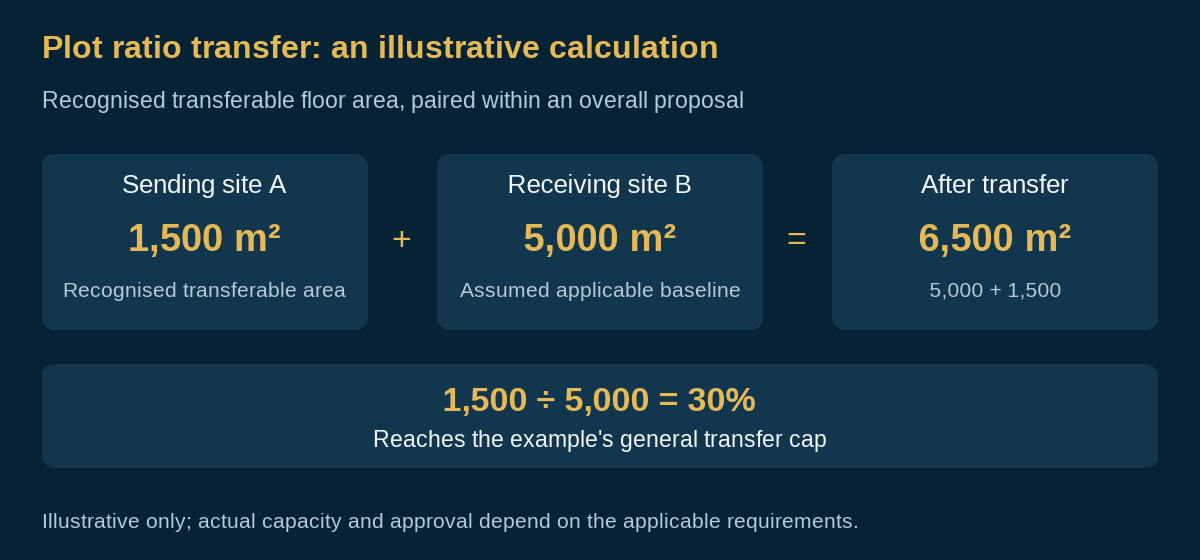
The following hypothetical figures explain the concept. Transferable floor area must be calculated from the plans, approved floor area and guidelines, rather than by adding up all measured floor space.[2]
Plan and explain both sites together
The sending and receiving sites must be included in the same section 16 application, explaining floor-area allocation, uses, technical impacts, implementation timing and management of public facilities. Depending on the approved scheme, the original site may involve public space, conservation or partial redevelopment. Its treatment after the transfer cannot be left unspecified.[2]
Pairing requires a complete proposal. Untransferred residual floor area cannot simply be 'banked' for use in a later application. Whether some floor area can be retained for redevelopment on the sending site depends on the guidelines and the individual proposal.[2]
03 / Implications for owners and sources
An extra option for small sites, if a suitable pairing can be found
Our analysis: cross-district pairing may create more options where an old-building site is small, difficult to amalgamate with neighbouring land or inefficient to redevelop in situ. Feasibility nevertheless depends on finding an eligible receiving site and coordinating the overall scheme, costs and implementation responsibilities.
How does this differ from the 20% additional plot ratio incentive?
| 20% incentive scheme | Cross-district plot ratio transfer |
|---|---|
| An incentive for eligible old-building redevelopment, with a choice of in-situ use or land-premium offset. | Reallocates recognised floor area from sending to receiving sites and requires an overall proposal. |
Both may be applied for together where the conditions are met. Approval, usable floor area and land-premium arrangements must be checked separately.[1][2][3]
Official sources
- [1] news.gov.hk: TPB allows cross-district plot ratio transfers 21 August 2026; changes, seven sending districts, receiving sites and interaction between the two schemes.https://www.news.gov.hk/chi/2026/08/20260821/20260821_193845_533.html
- [2] Town Planning Board Planning Guidelines 43A August 2026; sections 1–8, particularly paragraphs 3.2, 3.3, 4.6, 5.1 and 5.2.https://www.tpb.gov.hk/tc/forms/Guidelines/TPB_PG_43A.pdf
- [3] Joint Practice Note No. 9 (JPN 9) Paragraph 16(g): requirements when applying alongside the plot ratio transfer scheme.https://www.landsd.gov.hk/doc/en/practice-note/jpn/jpn09_e.pdf
The lead image is an AI-generated concept image; the calculation diagram was prepared by this publication. Individual cases remain subject to the latest plans, planning guidelines, land lease and departmental decisions.