
Use additional floor area on site, or convert it into a land-premium offset
The pilot scheme began on 1 September 2026
On 19 August 2026, the Development Bureau announced the pilot scheme for additional plot ratio to encourage private redevelopment in seven older districts. Eligible projects may use the additional floor area on site or convert the incentive into land-premium value. For owners of old buildings, the focus is the overall redevelopment proposal, not a direct entitlement to enlarge an individual flat.[1]
01 / Districts and eligibility
Building age alone is not enough: check four criteria together
Joint Practice Note No. 9 sets requirements for location, existing buildings, redevelopment use and site area. The following are initial screening points; plan boundaries, land composition and the stage already reached in redevelopment can also affect eligibility.[2]
| 7 | 50+ | 700 | >50% |
|---|---|---|---|
| Designated districts | Years of building age | Square metres or more | Residential share of total gross floor area |
| Check the lot against the designated boundary | Existing building has a residential element | May comprise one or more lots | Predominantly residential after redevelopment |
The seven designated districts
| Cheung Sha Wan | The relevant plan area also covers Sham Shui Po |
|---|---|
| Ma Tau Kok | Includes Kowloon City and To Kwa Wan |
| Mong Kok | Within the designated plan boundary |
| Sai Ying Pun and Sheung Wan | Together form one designated area |
| Tsuen Wan | Within the designated plan boundary |
| Wan Chai | Within the designated plan boundary |
| Yau Ma Tei | Within the designated plan boundary |
District names are a guide only. Check the designated plan boundaries; everyday neighbourhood names cannot determine eligibility.[1][2]
02 / Two choices and a simple calculation
Choose between extra floor area and a land-premium offset
Only one of the two options may be selected. Whether the in-situ proposal can use all the additional floor area depends on planning and design conditions. The premium-offset value follows the Government's standard amounts.[1][2]
Note: any unused balance cannot be converted into a premium offset, transferred to another project or exchanged for cash from the Government.[2]
Note: the offset is generally valid for 10 years, earns no interest and cannot be resold on the market. Arrangements involving related companies follow the requirements of the practice note.[1][2]
Figure 2 | How is the 20% calculated?
Assume an eligible site of 1,000 m², an applicable domestic plot-ratio baseline of 8, and that the whole site counts towards the incentive:
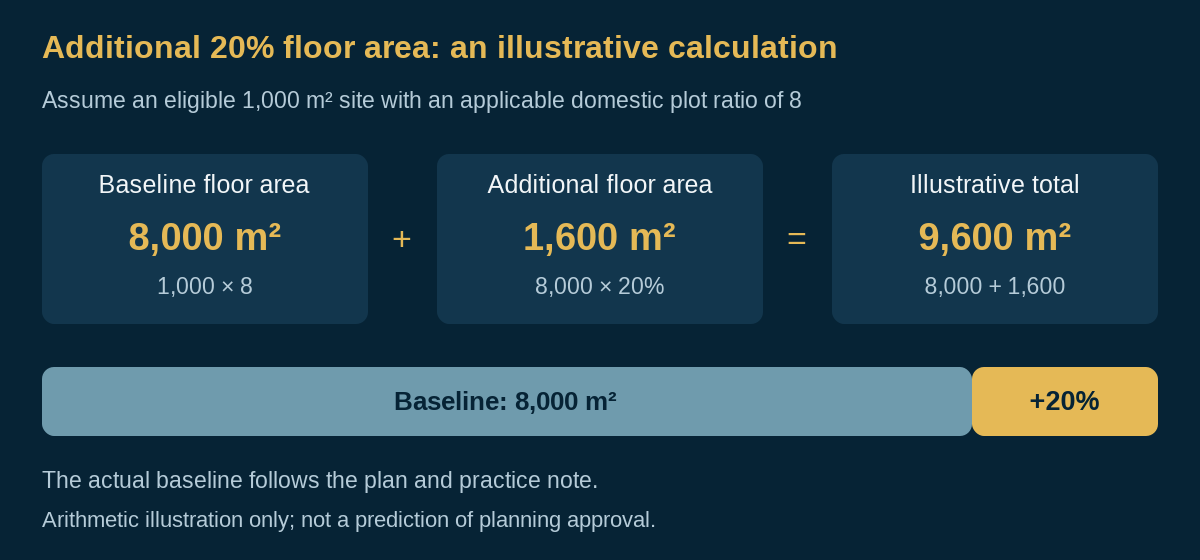
Read 'no additional land premium' in context: the incentive value offsets the relevant premium. It does not waive all land premiums, construction costs or other expenses of the redevelopment.[1][2]
03 / For owners and sources
Three things owners can do first
Ownership note: full ownership assembly may not be necessary when submitting the Option 1 planning application, but the required owner consent or notification must be completed. The necessary full ownership must be in place before submitting a lease modification or building plans. Joint ownership is acceptable.[2]
Official sources
- [1] Development Bureau: Pilot scheme for additional plot ratio to launch in September 19 August 2026; scheme period, seven districts, incentive options and premium-offset arrangements.https://www.info.gov.hk/gia/general/202608/19/P2026081900651.htm
- [2] Joint Practice Note No. 9 (JPN 9) August 2026; paragraphs 3 and 5–16 and the appendices detail eligibility, calculations, ownership and option restrictions.https://www.landsd.gov.hk/doc/en/practice-note/jpn/jpn09_e.pdf
- [3] news.gov.hk: Additional plot ratio pilot scheme to launch in September 19 August 2026; official Chinese-language overview of the scheme.https://www.news.gov.hk/chi/2026/08/20260819/20260819_193808_016.html
The lead image is an original AI-generated concept image; the calculation diagram was prepared by this publication. This article interprets the news. Individual cases remain subject to the latest plans, practice notes, land lease and departmental decisions.